

Losing the faceoff every single time is one of the most frustrating patterns in competitive table hockey. You know the puck is about to drop, your hands are ready, and somehow your opponent still walks away with possession. The difference between players who consistently win faceoffs and those who don’t almost always comes down to three things: knowing the ITHF faceoff rules, building the right mechanics, and practicing with purpose. This guide covers all three, from the official procedures to elite-level tactics you can apply in your next match.
Table of Contents
- Understanding the official faceoff rules
- Essential equipment setup for consistent results
- Step-by-step breakdown: Mastering the faceoff technique
- Troubleshooting: Common mistakes and how to fix them
- Practice routines to build elite faceoff reflexes
- Applying advanced strategies in competitive matches
- Ready to level up your table hockey game?
- Frequently asked questions
Key Takeaways
| Point | Details |
|---|---|
| Follow official rules | Mastering ITHF procedures guarantees every faceoff is legal and strategic. |
| Practice precision timing | Refining your anticipation and reaction boosts your win rate in competitive faceoffs. |
| Avoid common penalties | Checking your position and waiting for the signal prevents unnecessary redos and lost possession. |
| Use advanced tactics | Exploit redo rules and the crease zone for a competitive edge. |
| Consistent practice pays off | Daily drills and self-review build the habits needed for tournament success. |
Understanding the official faceoff rules
Before you can win a faceoff, you need to know exactly what legal play looks like. The ITHF sets the standard for all competitive table hockey, and faceoff rules are among the most precise in the rulebook.
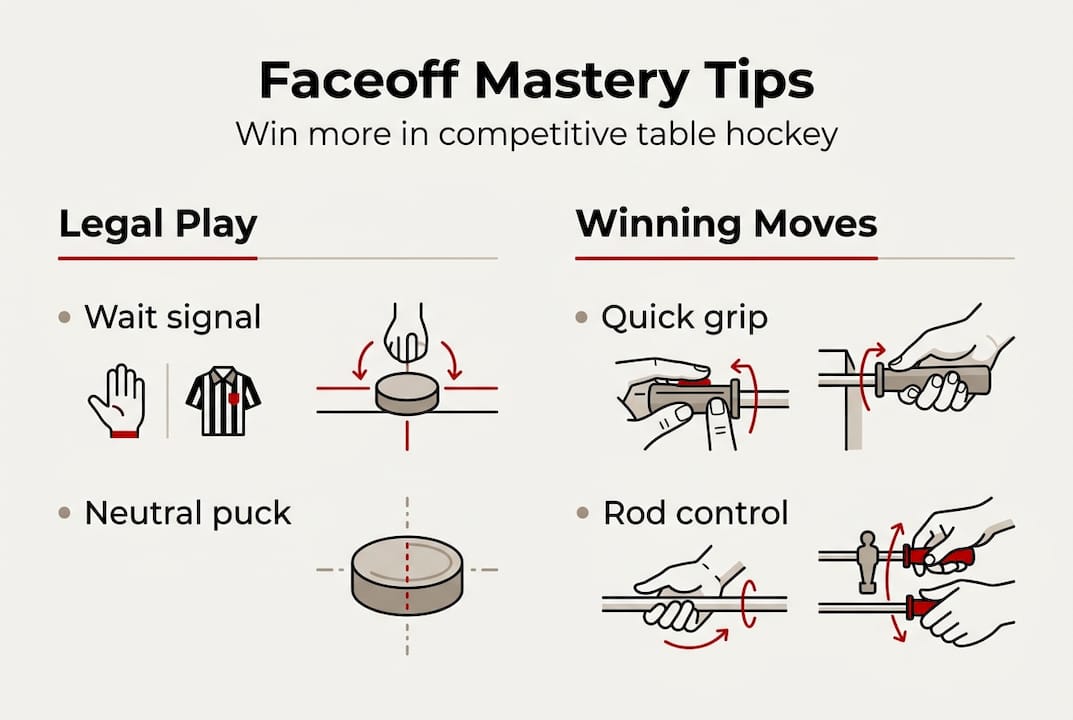
The faceoff procedure requires a neutral puck drop at center ice, with no player allowed to touch the center spot before the signal. Each player must keep their figures on their own side of the center line until the puck is in play. Any early movement triggers a redo, not a penalty on the first offense, but repeated violations can escalate.
Here is a quick breakdown of the key faceoff rules:
| Rule | What it means | Consequence for violation |
|---|---|---|
| Neutral puck drop | Referee drops puck at center | Redo if interfered with |
| No early contact | Rods must stay clear until drop | Redo or penalty |
| 3-second rule | No goal within 3 seconds of faceoff | Goal disallowed |
| Crease rule | Puck must leave crease before goal counts | Goal disallowed |
| Side positioning | Players stay on their half | Redo or loss of possession |
A few critical points every player should know:
- Only the center rod player contests the faceoff directly.
- A redo is called when both players move early or when the drop is deemed unfair.
- Goals scored within 3 seconds of a faceoff do not count, even if the puck clearly crossed the line.
- Crease violations can nullify an otherwise clean goal.
Understanding table hockey penalties beyond faceoffs will also help you recognize when a referee’s call is correct and when you have grounds to request a redo.
Essential equipment setup for consistent results
Rules knowledge alone won’t win faceoffs if your equipment is working against you. The table you play on, the condition of your rods, and even how dry your hands are all affect your reaction time and control.
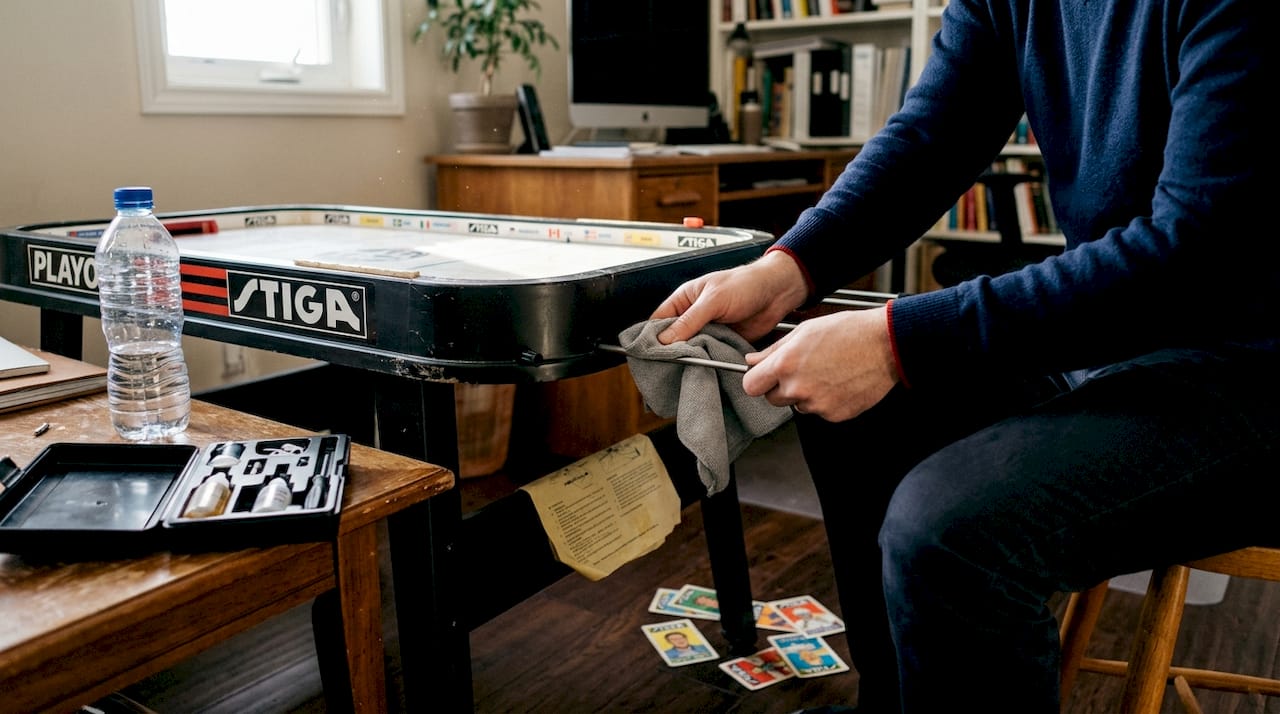
Stiga Playoff games are standard for competitive play, offering quick setup and consistent performance across tournaments. The thicker playing surface and in-mold counters make for a predictable puck drop, which is exactly what you want when training your reflexes.
Here is how common table setups compare for faceoff play:
| Table type | Puck drop consistency | Rod responsiveness | Tournament legal |
|---|---|---|---|
| Stiga Playoff | High | Excellent | Yes |
| Stiga Stanley | Medium | Good | Limited |
| Generic tabletop | Low | Variable | No |
| Custom builds | Variable | Depends on parts | Case by case |
For rod control, learning how to grip table hockey rods correctly is one of the fastest ways to improve your faceoff reaction. A loose or inconsistent grip costs you milliseconds, and at the faceoff, milliseconds are everything.
Pro Tip: Wipe your rods with a dry cloth before every match and keep your hands dry. Sweaty palms reduce grip precision and slow your initial rod movement by a noticeable margin.
Board maintenance matters too. Check that your rods slide smoothly and that the center ice area is clean and free of debris. A sticky rod during a faceoff is a guaranteed loss.
Step-by-step breakdown: Mastering the faceoff technique
Now that your setup is dialed in, here is how to execute a faceoff with precision and intent.
- Pre-faceoff positioning. Place your center figure at the exact center spot, not slightly left or right. Symmetrical positioning gives you equal access to both sides of the puck drop.
- Grip and stance. Hold the center rod with a firm but relaxed grip. Tension in your forearm slows your reaction. Think of it like holding a pen, firm enough to control, loose enough to move fast.
- Eye focus. Watch the referee’s hand, not the puck. The moment the hand releases, your rod should already be moving.
- Rod angle before drop. Position your center figure at a slight angle toward your attack zone. This gives you a directional advantage the instant the puck lands.
- Puck contact. Winning faceoffs requires precise timing on puck drop, rod positioning without early interference, and immediate puck control after contact.
- Transition to attack. The moment you win possession, push the puck toward your winger or defenseman immediately. Don’t hold at center. Use the 3-second rule window to set up your first real scoring opportunity.
- Reset if you lose. If your opponent wins the drop, shift immediately to a defensive position. Don’t chase the puck with your center rod.
Pro Tip: Practice reacting to both fast and slow opponent puck drops. In real matches, referees vary their drop speed. Training only for one pace leaves you vulnerable.
For players ready to go deeper, advanced table hockey skills cover how faceoff wins connect to broader offensive and defensive systems.
Troubleshooting: Common mistakes and how to fix them
Even experienced players make the same faceoff mistakes under pressure. Recognizing them early is the fastest way to stop losing possession you should be winning.
Early rod movement during puck drop leads to a redo, and positioning errors or improper puck handling can risk penalties or lost possession. Here are the most common issues and how to correct them:
- Moving too early. This is the most frequent mistake. Fix it by shifting your focus from the puck to the referee’s hand. React to the release, not the anticipation.
- Incorrect figure angle. If your center figure is flat, you lose directional control the instant the puck lands. Practice setting a slight attack angle before every drop.
- Gripping too tight. A death grip on the rod slows your movement. Loosen up between faceoffs and reset your grip before each drop.
- Ignoring the crease rule. Players sometimes score what looks like a clean goal only to have it disallowed because the puck never fully left the crease. Know the boundary.
- Failing to transition. Winning the faceoff and then stalling at center is almost as bad as losing it. Have a plan for where the puck goes before the drop happens.
The best faceoff players are not faster than everyone else. They are more prepared. They know where the puck is going before it even drops.
Review table hockey penalties regularly so you understand the full cost of repeated faceoff violations in tournament settings.
Practice routines to build elite faceoff reflexes
Consistent practice focused on timing, anticipation, and rule compliance sharpens competitive faceoff skills more than any single technique adjustment. Here is how to structure your training:
- Solo drop drills. Use a coin or small object to simulate a puck drop. Drop it yourself and react with your center rod. This trains your eye-hand connection without needing a partner.
- Mirror practice. Record yourself during faceoffs and watch the footage. You will spot early movement and grip issues that feel invisible in the moment.
- Timed reaction sets. Have a training partner vary the drop timing, fast, slow, and delayed. Count how many out of 10 drops you win clean possession.
- Pressure simulation. Play short 5-minute sets where every faceoff result is tracked. Simulating tournament pressure changes how your body responds to the drop.
- Rule review sessions. Once a week, read through the ITHF faceoff rules. Knowing them cold means you never lose a redo opportunity because you forgot a procedure.
Tracking your results matters. Use tools to track table hockey progress to log faceoff win rates over time and identify patterns in your performance. For players looking to connect faceoff work to full-game improvement, advanced table hockey techniques offer the next layer of skill development.
Applying advanced strategies in competitive matches
Once your mechanics are solid, the next level is using the rules and your opponent’s psychology to gain an edge before the puck even drops.
Advanced strategies include exploiting redos, using the crease rule for defense, and maintaining focus under tournament pressure. Here is how elite players apply this in practice:
- Request redos strategically. If you notice your opponent is getting into a rhythm, a legitimate redo request breaks their focus and resets the moment.
- Use the crease rule as a defensive tool. If you lose the faceoff, positioning a defender near your crease can nullify a rushed shot that would otherwise count.
- Read your opponent’s setup. Watch where they angle their center figure before the drop. Most players have a default direction. Anticipate it.
- Control your own body language. Nervous players telegraph hesitation. Steady hands and a consistent pre-faceoff routine signal confidence and can unsettle opponents.
- Set the tone early. Winning the first two or three faceoffs of a match shifts momentum. Opponents start pressing, which leads to early movement violations and redos in your favor.
Studying table hockey statistics from competitive matches shows a clear pattern: players who win more than 60% of faceoffs control possession and dictate pace. Combine this with table hockey play strategies and stay current with table hockey trends to keep your game evolving.
Ready to level up your table hockey game?
You now have the rules, the mechanics, the troubleshooting framework, and the competitive tactics to win more faceoffs starting with your next match. The gap between knowing and doing closes fast when you have the right resources and the right community around you.
Table Hockey Global is the world’s biggest table hockey community, built for players at every level. Whether you are a beginner learning legal faceoff positioning or an advanced player hunting for competitive edges, you will find guides, drills, equipment advice, and a global network of players who share your passion. Join the community, connect with players worldwide, and keep building your game with people who take table hockey as seriously as you do.
Frequently asked questions
What makes a faceoff legal in table hockey?
A legal faceoff follows ITHF positioning and readiness rules: both players must wait for the puck drop signal, stay on their side of the center line, and only make contact after the puck is released.
Why is the 3-second rule important after a faceoff?
The 3-second rule disallows goals scored immediately after a faceoff, giving both players a fair window to respond before a shot can count.
How should I practice faceoffs effectively?
Repeat drills and match simulation build the timing and anticipation you need. Focus on legal setup, vary your drop speeds, and track your win rate to measure real improvement.
What are common penalties during faceoffs?
Early movement and illegal positioning are the most frequent violations, typically resulting in a redo. Repeated offenses can escalate to a formal penalty depending on the referee.
How do advanced players gain an edge in faceoffs?
They exploit redos and crease rules strategically, read opponent tendencies before the drop, and maintain composure under tournament pressure to react faster and more accurately.
Recommended
- Master advanced table hockey techniques for competitive play – Table Hockey Global
- Master advanced table hockey play: skills and strategies 2026 – Table Hockey Global
- Master balance in table hockey: 10% faster shots – Table Hockey Global
- Top table hockey trends transforming play in 2026 – Table Hockey Global