

TL;DR:
- Table hockey lacks power plays and player ejections found in ice hockey.
- Skills like rod control, passing, and shooting are essential for young players.
- Success depends on practicing fundamental skills and good sportsmanship, not rule manipulation.
Parents searching for table hockey power play strategies often carry over ice hockey concepts that simply do not apply. Power play is a penalty-based man advantage in ice hockey, but no equivalent mechanic exists in table hockey. This article clears up that confusion and gives you the actual strategies worth teaching your 8 to 15 year old. You will find real skill breakdowns, practical drills, and clear explanations of how table hockey rules actually work, so your child builds genuine game ability from day one.
Table of Contents
- What is a power play in ice hockey versus table hockey?
- The real table hockey strategies parents should teach
- Why penalties and ‘man-advantage’ don’t exist in table hockey
- How to build game sense and teamwork for young table hockey players
- Why ‘power play’ is a distracting myth for table hockey learners
- Next steps: Equip your family for table hockey fun
- Frequently asked questions
Key Takeaways
| Point | Details |
|---|---|
| No power plays | Table hockey does not include power play or man-advantage scenarios. |
| Core skills matter | Rod control, passing, and defense are the best skills to teach young players. |
| Strategy over penalties | Focusing on gameplay tactics develops real table hockey success, not penalty rules. |
| Teamwork boosts learning | Shared practice and positive coaching build skills, teamwork, and enjoyment. |
What is a power play in ice hockey versus table hockey?
In ice hockey, a power play happens when one team has more players on the ice than the other. A player commits a penalty, gets sent to the penalty box, and their team must defend with fewer skaters, usually four against five. The team with more players has a clear scoring advantage. This is called a man advantage, and it is a core part of ice hockey strategy.
Table hockey works completely differently. Every player always controls a full team through a set of rods. There are no penalty boxes, no player ejections, and no timed man-advantage situations. The absence of power plays in table hockey is not a gap in the rules. It is simply how the game is designed. Each rod controls a row of players, and those rods never go away mid-game.
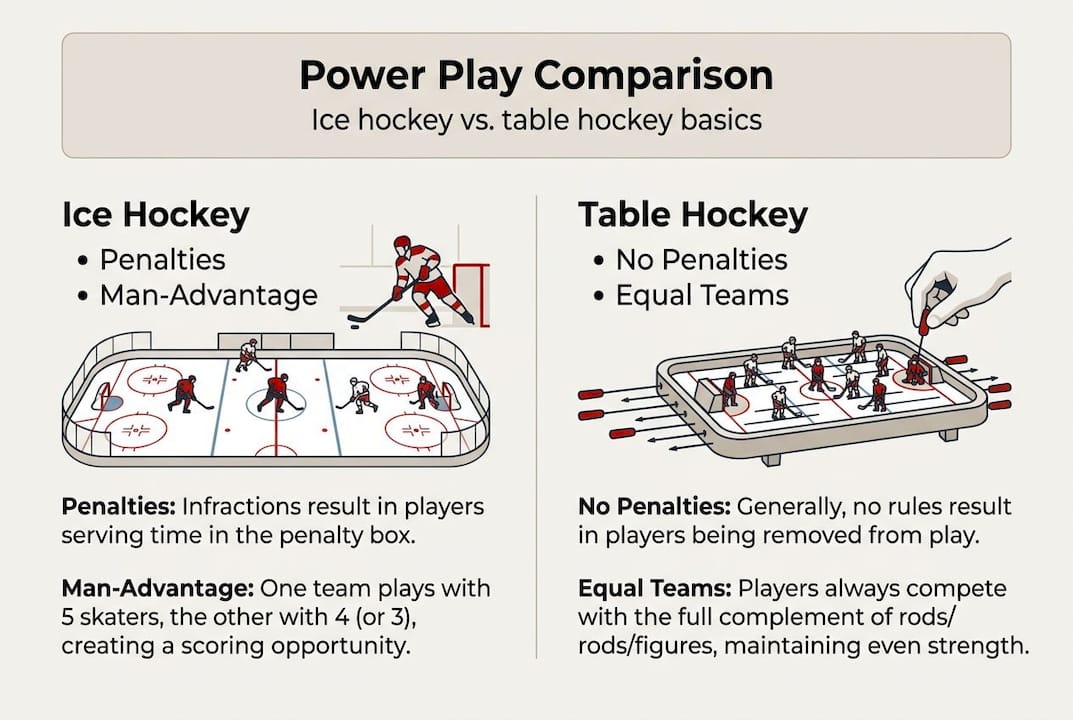
The confusion between the two games is understandable. Both involve hockey, a puck, and competitive play. Parents who grew up watching NHL games naturally bring that vocabulary to the table. But the mechanics are entirely separate.
Here is a direct comparison to make the difference clear:
| Feature | Ice hockey | Table hockey |
|---|---|---|
| Power play rule | Yes, penalty-based | No |
| Player ejections | Yes | No |
| Man-advantage play | Yes, 5-on-4 or 5-on-3 | No |
| Penalty box | Yes | No |
| Full team always active | No | Yes |
| Strategy focus | Penalty exploitation | Rod control and positioning |
“The query likely confuses table hockey with ice hockey, where power play is a penalty-based man advantage. No equivalent mechanic exists in table hockey.”
Some parents also confuse table hockey with foosball, which adds another layer of mix-up. Both use rods, but foosball uses a ball and different player configurations. Table hockey uses a puck and mirrors the layout of an actual hockey rink. Understanding table hockey penalties and fair play etiquette helps clarify what the game actually covers and what it does not.
The bottom line: if your child asks about power plays at the table hockey table, the honest answer is that they do not exist here. Redirect that curiosity toward what does matter, which is skill.
The real table hockey strategies parents should teach
Now that power plays are off the table, here are the skills that actually move the needle for young players. Rod control, passing, shooting, and bank shots are the building blocks of strong table hockey play for kids aged 8 to 15.
Here are the core skills to prioritize:
- Rod control. Each rod moves two ways: side to side and spin. Teaching your child to use both motions fluidly is the foundation of everything else. Sloppy rod control leads to missed passes and weak shots.
- Passing techniques. Smart passing means moving the puck between your own rods before shooting. A child who only shoots from one position is easy to defend. Teach them to shift the puck across rods to create better angles.
- Shooting angles. Not all shots are equal. Shots from the center are predictable. Shots from wide angles or after a fake pass are harder to block. Practice shooting from different positions on the rod.
- Defensive positioning. The defensive rods need active management. Many beginners leave their defenders flat. Teach your child to angle defenders to cover more of the goal mouth.
- Bank shots. Using the side walls to redirect the puck is a creative and effective technique. It catches opponents off guard and opens up goal opportunities that straight shots miss.
Pro Tip: Set up 10-minute focused drills on one skill at a time. Trying to practice everything at once leads to no real improvement in any area. One session on passing, one on defense, one on bank shots builds faster progress.
Learning table hockey positions in detail helps kids understand why each rod matters. For players ready to go further, advanced table hockey techniques cover the finer points of competitive play. You can also explore how connecting with your kids through table hockey strengthens both skill and relationship.
Why penalties and ‘man-advantage’ don’t exist in table hockey
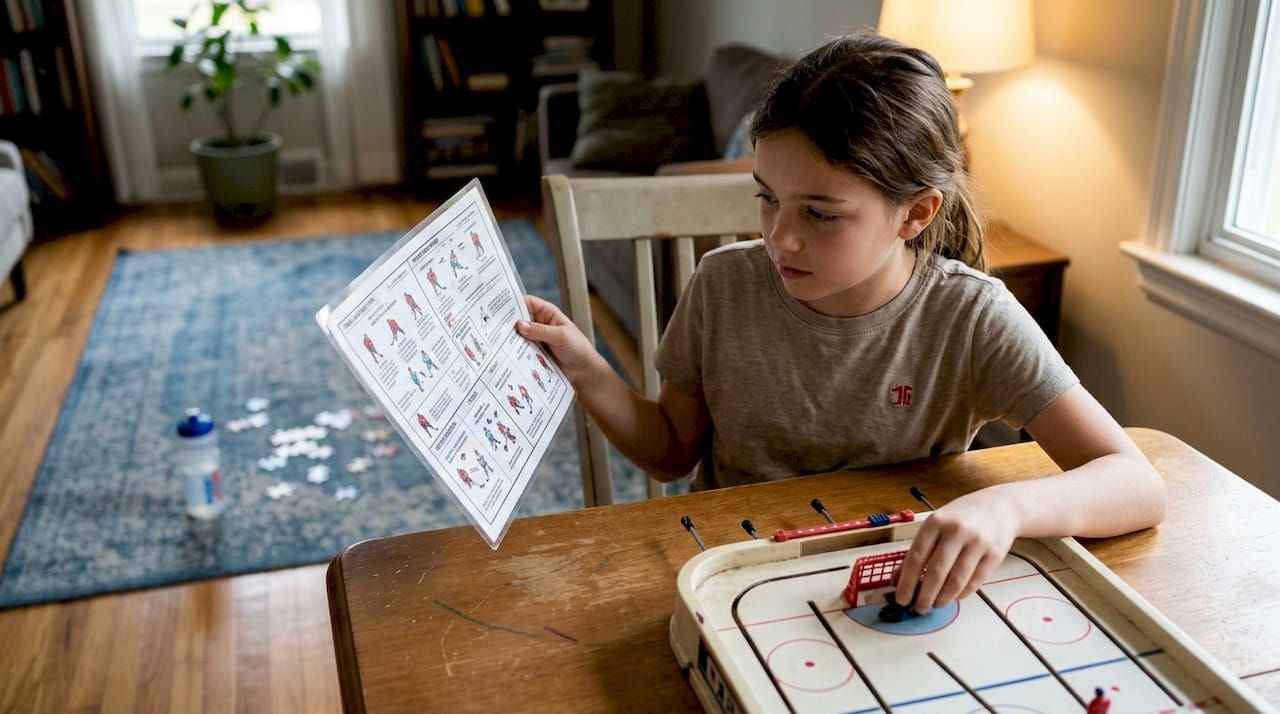
Let’s go deeper into why man-advantage play is structurally impossible in table hockey. The game’s physical design removes the option entirely.
In table hockey, each player controls a set of rods that run across the width of the table. Those rods hold fixed rows of player figures. You cannot remove a rod from play. You cannot lock a rod in place as a penalty. The game does not have a mechanism for reducing one side’s active players.
Here is how table hockey infractions are actually handled:
- Stuck puck. If the puck gets stuck and neither player can move it, both players agree to a face-off restart.
- Table interference. If a player shakes or lifts the table, the opponent may be awarded a free shot, depending on house rules.
- Out-of-bounds puck. If the puck leaves the playing surface, play restarts from a neutral position.
- Spinning violations. In some competitive formats, spinning a rod 360 degrees repeatedly is discouraged, but it results in a warning or point deduction, not a man-advantage situation.
| Infraction type | Ice hockey response | Table hockey response |
|---|---|---|
| Physical foul | Penalty, player removed | No equivalent |
| Delay of game | Penalty shot or faceoff | Restart or house rule |
| Equipment issue | Stoppage, repair | Pause and resume |
| Unsportsmanlike conduct | Penalty minutes | Verbal warning or etiquette |
All sources confirm the absence of power plays in table hockey rules. Gameplay focuses on direct control of all players via rods at all times. Understanding team roles in table hockey helps kids see how each rod position contributes to overall play. For tournament-level clarity, championship table hockey rules outline exactly what is and is not permitted at the competitive level.
The key takeaway for parents: do not look for penalty exploitation in table hockey. The game rewards skill, not rule manipulation.
How to build game sense and teamwork for young table hockey players
With a clear picture of what table hockey actually involves, here is how to build real skills and teamwork in your child.
- Run passing drills together. Sit across from your child and practice moving the puck between rods without shooting. Count how many clean passes you can complete before a shot. This builds rod coordination and patience.
- Set up defensive challenges. Attack with one rod while your child defends with their defensive rod only. Switch roles. This isolates the defensive skill and makes improvement measurable.
- Practice bank shot sequences. Mark a spot on the side wall with tape and challenge your child to hit it from different rod positions. Bank shots require spatial thinking and reward creativity.
- Play short games with a single focus. Instead of full games, play to five goals with one rule: every goal must come from a pass first. This forces strategic play over random shooting.
Pro Tip: After each game, spend two minutes reviewing one thing that worked and one thing to improve. Keep it specific. “Your passing on the center rod was sharp” is more useful than “good game.” Post-game reflection builds skills and strategies for table hockey faster than extra game time alone.
Sportsmanship matters too. Model calm behavior when the puck bounces the wrong way. Kids learn how to handle frustration by watching how you handle it. Building confidence in table hockey comes from consistent, low-pressure practice sessions where mistakes are treated as data, not failures.
The rod control and passing focus recommended for young players is backed by practical coaching experience. Consistent repetition of core skills outperforms any shortcut.
Why ‘power play’ is a distracting myth for table hockey learners
Here is our take at Table Hockey Global: chasing the idea of a power play in table hockey wastes time that could go toward actual skill development. When kids spend energy looking for a mechanic that does not exist, they miss the real game in front of them.
Table hockey rewards players who master rod control, creative passing, and smart positioning. Those skills take time to build. Every session spent on a fictional concept is a session not spent on what actually wins games.
Parents have the most influence here. When you frame table hockey as a skill game, not a penalty game, your child learns to focus on what they can control. That mindset carries beyond the table.
The best young players we see in the Table Hockey Global community are not the ones who know the most rules. They are the ones who practiced the basics until those basics became instincts. Table hockey team building with kids is where that foundation gets built, one session at a time.
Next steps: Equip your family for table hockey fun
Ready to put these strategies into practice? The right equipment makes a real difference when teaching young players.
The Table Hockey Starter Kit from Table Hockey Global gives families a reliable, beginner-friendly setup that supports the skill drills covered in this article. Rod control, passing practice, and bank shot work all start with a quality table. Browse the table hockey collections for summer to find options that fit your space and budget. Table Hockey Global connects players at every level, from first-time families to competitive adults, so your child can grow with the game for years.
Frequently asked questions
Is there ever a power play situation in any table hockey tournament?
No. Table hockey has no power play rules or man-advantage situations at any level, including advanced tournaments. The game’s rod-based design makes it structurally impossible.
What skills are most important for young table hockey players?
Rod control, passing, and defense are the most important skills for players aged 8 to 15. Bank shots and shooting angles become important as players develop.
How do you handle rule disputes in table hockey without penalties?
Most table hockey games use player etiquette and sportsmanship to resolve disputes. Formal penalty mechanics do not exist, so restarts and house rules fill that role.
How can parents use table hockey to teach teamwork?
Parents can build teamwork through shared drills and communication during play sessions. Post-game feedback focused on specific actions reinforces both skill and cooperative thinking.
Recommended
- Master advanced table hockey play: skills and strategies 2026 – Table Hockey Global
- Table hockey team roles: guide for players and fans – Table Hockey Global
- Table hockey statistics guide: players and fans 2026 – Table Hockey Global
- Table hockey vs air hockey: best family game for 2026 – Table Hockey Global