

Most people assume table hockey is a casual living room game. It is not, at least not in its competitive form. Swedish style table hockey is a structured, skill-based sport played under international rules, with organized tournaments drawing players from over a dozen countries. This guide covers what Swedish style is, how it works, what equipment is used, and how players at every level can get started. Whether you are a parent looking to introduce your child to competitive play or an enthusiast ready to level up, this breakdown gives you the full picture.
Table of Contents
- What is Swedish style table hockey?
- Key mechanics and equipment used
- Rules and gameplay: How Swedish style works
- Tactics and techniques: From beginner to advanced
- Swedish style on the world stage
- Ready to play or learn more about Swedish style?
- Frequently asked questions
Key Takeaways
| Point | Details |
|---|---|
| Origins in Sweden | Swedish style emerged with Stiga tables and set the worldwide standard for competitive play. |
| Unique equipment and rules | Matches follow ITHF rules with open-rod Stiga Play-off tables, focusing on precise rod mechanics. |
| Global competitive scene | Swedish style table hockey now features major tournaments with international participation and evolving champions. |
| Skill-based, accessible play | Players can start with basics and develop advanced techniques, making it fun for families and pros alike. |
What is Swedish style table hockey?
Swedish style table hockey is the competitive variant of rod table hockey played on Stiga tables under ITHF (International Table Hockey Federation) rules. The ITHF table hockey format originated in Sweden and became the global standard for organized play.
Stiga tables first appeared in Sweden in the late 1950s. Competitive play followed decades later, with the first official Swedish Championship held in 1982. That event marked the beginning of structured, rules-based table hockey as a recognized sport.
Swedish style table hockey is defined by open-rod Stiga tables, ITHF rules, and a focus on precise mechanical skill rather than luck or table movement.
Key features that define Swedish style:
- Played on Stiga Play-off tables with a factory-set surface
- Governed by ITHF rules for all official matches
- Open-rod design, no bubble or dome cover
- Figures with sticks on one side only
- Tables fastened down to prevent movement during play
For a deeper look at the history of these tables, the Stiga Play-off history page covers the full timeline from early production to modern tournament use.
Key mechanics and equipment used
The equipment in Swedish style table hockey is not interchangeable. Specific tables, figures, and setup rules are required for official play.
Stiga Play-off tables are the standard. The surface speed is uniform and factory-set, meaning no modifications are allowed. Tables are physically fastened to a surface during matches to eliminate any advantage from nudging or tilting. Goal cups behind the nets are removed, and backing plastic glasses are installed to keep pucks in play rather than flying off the table.
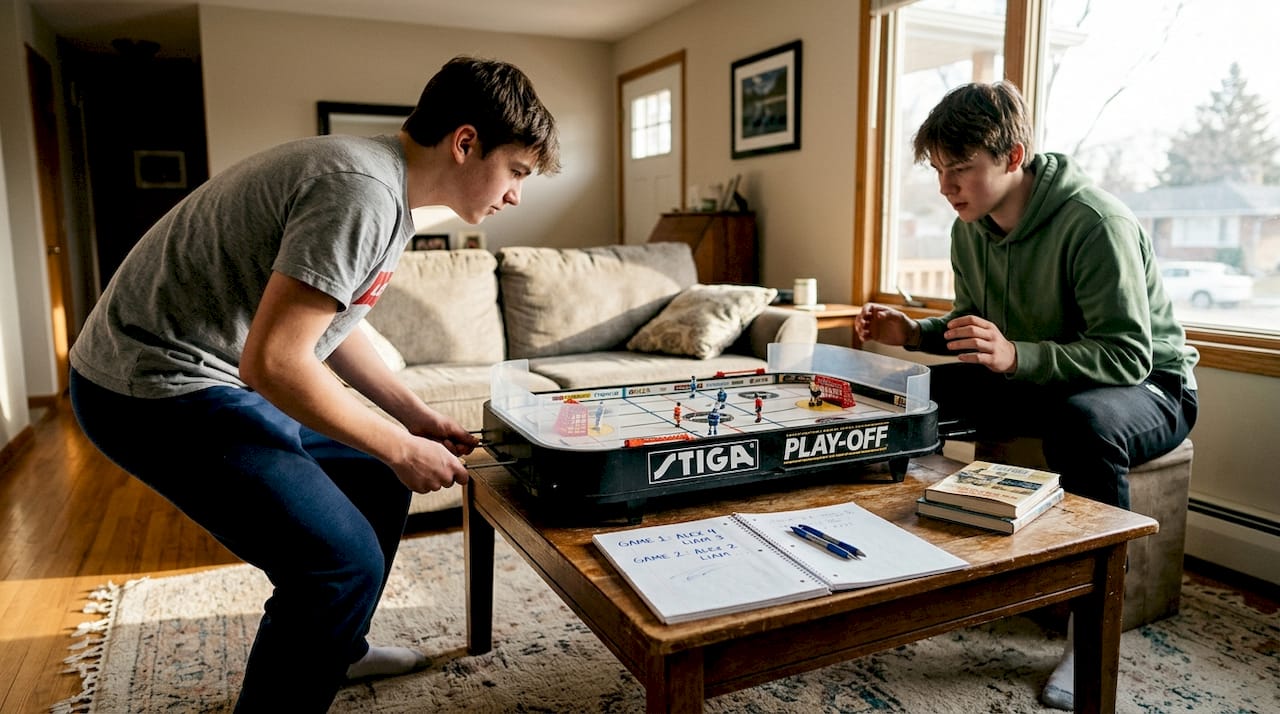
Figures used in Swedish style have sticks on one side only. This design increases the precision required to control the puck and rewards deliberate rod movement over random spinning.
| Feature | Swedish style | Bubble hockey |
|---|---|---|
| Table type | Stiga Play-off, open rod | Coleco or WTHA, domed |
| Figure design | One-sided stick | Two-sided or spinning |
| Table movement | Not allowed, fastened | Often unrestricted |
| Goal cups | Removed | Standard |
| Skill focus | Rod precision | General play |
As confirmed by ITHF table hockey documentation, Swedish style uses open-rod Stiga tables without bubble covers, contrasting directly with North American bubble hockey formats like Coleco or WTHA.
Pro Tip: If you are setting up a table for practice at home, fasten it to a stable surface and remove the goal cups. This replicates official conditions and builds habits that transfer directly to tournament play. More on Stiga table construction can help you configure your setup correctly.
Rules and gameplay: How Swedish style works
Swedish style matches follow a clear structure. Knowing the rules before you play saves confusion and builds competitive awareness from the start.
Here is how a standard match runs:
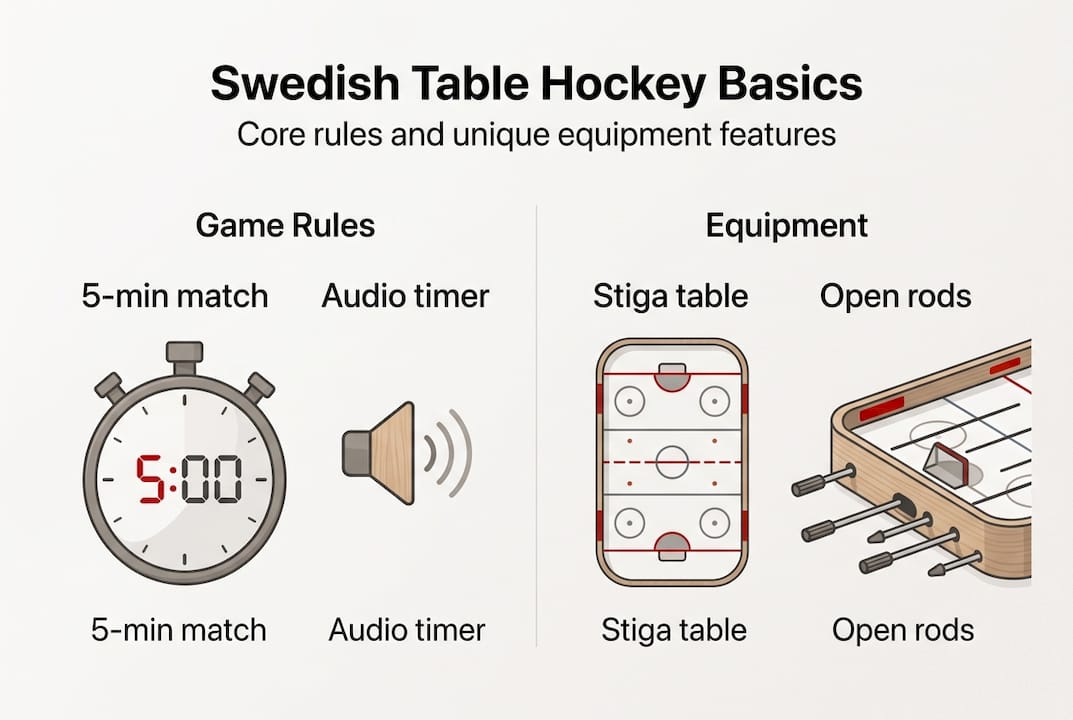
- Match duration: Each match lasts exactly 5 minutes. The audio timer runs continuously, even when the puck is out of play.
- Face-off procedure: Every play starts with a face-off on the center spot. The puck is dropped, and on the signal, play begins. The puck must hit the sideboards or another figure before the goalie can play it.
- Scoring: Only goals scored through legal rod-handling count. Any goal resulting from table movement is disallowed.
- Overtime: If the score is tied after 5 minutes, sudden-death overtime begins. The first goal wins the match.
The 5-minute match format with a continuously running audio timer is one of the defining features of Swedish style. Time does not stop for stoppages, which adds pressure and rewards players who stay focused throughout.
Face-off rules are strict. The center spot face-off procedure requires the puck to contact the sideboards or another figure before the goalie can touch it. This prevents immediate defensive stalling and keeps the game moving. For players looking to gain an edge from the opening seconds, faceoff strategies break down how to control possession right from the drop.
Key stat: The Swedish Masters 2025 featured 161 players from 12 countries, all competing under these exact rules.
Tactics and techniques: From beginner to advanced
Swedish style rewards players who invest time in learning rod mechanics. Spinning figures, which is common in casual play, is not effective here. The format emphasizes precise rod mechanics over spinning, which means every skill you build has a direct impact on your results.
Start with these foundational skills:
- Rod control: Practice pushing and pulling each rod smoothly and quickly
- Passing: Move the puck between rods with intention, not just reaction
- Shooting: Develop a consistent shooting motion from the forward rod
- Goalie positioning: Learn to read the play and move your goalie proactively
Once the basics are solid, more advanced play opens up. Quick give-and-go combinations, coordinated attacks using multiple rods, and deliberate goalie maneuvers all become part of your toolkit. Players who reach this level are thinking several moves ahead, not just reacting.
Common mistakes to avoid:
- Relying on luck or random puck movement
- Moving the table during play
- Mistiming rod movements and losing puck control
- Ignoring goalie positioning until it is too late
Pro Tip: Record yourself playing and watch it back. You will spot rod timing errors and positioning gaps that are invisible in the moment. Combine this with resources like advanced rod techniques and faster shots in table hockey to build a structured improvement plan.
Tracking your progress matters too. Using structured methods from improving table hockey skills helps you identify patterns and measure real growth over time. For players ready to compete, table hockey strategies covers match-level thinking in detail.
Swedish style on the world stage
Sweden built the foundation of competitive table hockey and dominated it for decades. The country won all Team World Championships until 2005, a run that established Swedish players as the benchmark for the sport globally.
The competitive landscape has shifted significantly since then. Latvia, Finland, Ukraine, and Russia have all produced top-ranked players and championship teams. The sport is no longer a Swedish monopoly, and that diversity has raised the overall level of play.
| Tournament | Year | Players | Countries |
|---|---|---|---|
| Swedish Masters | 2025 | 161 | 12 |
| World Tour (top points) | Current | Multiple | Many |
The Swedish Masters 2025 drew 161 players from 12 countries, making it one of the largest single table hockey events on record. World Tour rankings are calculated based on the last two years of tournament performance, with the top point total reaching 3,208.
The World Tour ranking system rewards consistency across multiple tournaments, not just single-event performance.
Youth participation is growing. More families are introducing Swedish style at home before moving into club and tournament play. The format works for all ages because the rules are clear, the equipment is accessible, and the skill ceiling is high enough to keep experienced players engaged for years.
For players tracking their standing, player statistics and rankings provides a breakdown of how rankings work and what to aim for. The current trends in table hockey page covers how the sport is evolving globally, and table hockey in Europe maps out the regional scene in detail.
Ready to play or learn more about Swedish style?
Swedish style table hockey is structured, skill-based, and genuinely competitive at every level. The rules are clear. The equipment is specific. The techniques take time to build but reward consistent practice.
Table Hockey Global is the world’s largest community for table hockey players, from first-time beginners to seasoned tournament competitors. You can find guides on technique, equipment setup, and match strategy, all in one place. Whether you are setting up your first Stiga table at home or preparing for your next tournament, the community connects you with players at every level around the world. Start with the full breakdown on Stiga Table Hockey details to make sure your setup matches official standards before your first competitive match.
Frequently asked questions
What tables are used in Swedish style table hockey?
Swedish style always uses Stiga Play-off tables, which have a smooth factory-set surface and open rods designed for precise rod-based gameplay.
How is Swedish style table hockey different from bubble hockey?
Swedish style uses open-rod Stiga tables with no bubble covers and focuses on skillful rod mechanics, not spinning players or domed enclosures like Coleco or WTHA formats.
How long does a match last and how is overtime played?
Matches last 5 minutes with an audio timer running continuously, and if the score is tied at the end, sudden-death overtime begins where the next goal wins.
Why is Sweden famous in table hockey?
Sweden won all Team World Championships until 2005 and dominated most individual titles through 2007, establishing the country as the historic center of competitive table hockey.
Can kids and families enjoy Swedish style table hockey?
Yes. Swedish style table hockey is played competitively by kids, adults, and families at all skill levels, and the clear rules make it easy to learn and enjoyable to practice at home.
Recommended
- Master advanced table hockey play: skills and strategies 2026 – Table Hockey Global
- Master advanced table hockey techniques for competitive play – Table Hockey Global
- Table hockey statistics guide: players and fans 2026 – Table Hockey Global
- Master table hockey faceoffs: techniques for competitive play – Table Hockey Global