

TL;DR:
- Table hockey was invented in 1932 in a Toronto basement using household scraps.
- The sport has three main types: rod hockey, bubble hockey, and flat-figure rod hockey.
- It has grown globally, with official tournaments and a rich competitive history since the 2000s.
Table hockey started not in a factory or a sports lab, but in a Toronto basement during one of the hardest economic periods in modern history. In 1932, Donald H. Munro Sr. built the first table hockey game as a Christmas gift for his children, using scraps he found around the house. That single act of resourcefulness launched a sport now played by millions across dozens of countries. Whether you are a competitive player, a curious fan, or a parent looking for a fun way to connect with your kids, the history of table hockey is full of surprising twists, clever engineering, and global milestones worth knowing.
Table of Contents
- Invented in a basement: Birth of table hockey
- Types of table hockey games: Rod, bubble, and flat figures
- Global rise: Table hockey’s expansion and key milestones
- Official rules and fascinating gameplay twists
- Why table hockey’s past is key to its future (and your family playroom)
- Ready to play or learn more? Join the global table hockey community
- Frequently asked questions
Key Takeaways
| Point | Details |
|---|---|
| Table hockey’s humble origins | Invented from household scraps, table hockey started as a creative family gift. |
| Diverse game styles | Rod, bubble, and flat-figure tables bring variety to play for both beginners and experts. |
| Global community | The ITHF connects fans worldwide through standardized tournaments and shared traditions. |
| Strategic and fun play | Official rules ensure every game balances skill, fairness, and excitement. |
| Timeless family appeal | Table hockey remains a hands-on, engaging way for families and friends to connect. |
Invented in a basement: Birth of table hockey
The origin story of table hockey reads like something from a crafting manual, not a sports history book. Donald H. Munro Sr. assembled the first game using clothespins, wire, and an old ironing board. The result was a working tabletop rink where players could actually move and shoot. It was crafted from household scraps as a Christmas gift during the Great Depression, when store-bought toys were out of reach for most families.
“The first table hockey game was never meant to be a product. It was a father’s solution to a problem: how do you give your kids something special when you have almost nothing?”
What makes this origin stand out is the mechanical thinking behind it. Munro did not just build a static board. He engineered moving parts from everyday objects. The early design actually resembled pinball more than modern table hockey. Players were fixed to rods and could slide and rotate, but the overall layout changed significantly as Munro refined the concept and filed new patents.
Here are some key facts from those early years:
- The game was first built in 1932 in Toronto, Canada
- Household items like clothespins and wire were the core materials
- An ironing board served as the playing surface
- Early designs were closer to pinball mechanics than today’s rod hockey
- Munro later commercialized the game and sold it to families across Canada
The family fun with table hockey appeal was baked in from day one. This was not a competitive product built for tournaments. It was a parent trying to make his children happy. That spirit carries forward into modern family play, where the game remains one of the best ways to get everyone around a table without a screen in sight.
Pro Tip: If you want to introduce table hockey to younger kids, start with a simple rod hockey set and let them experiment with the mechanics. The team building benefits of playing together are real, and the learning curve is short enough to keep children engaged from the first game.
Types of table hockey games: Rod, bubble, and flat figures
Once you know where table hockey came from, the next step is understanding what kinds of games exist today. Not all table hockey is the same. The type you play at home, at an arcade, or in a tournament can vary quite a bit in design and mechanics.
Rod hockey is the most common format. Brands like Stiga and Franklin produce models where 3D player figures are attached to rods that run across the width of the table. You slide the rods left and right and spin them to pass, shoot, and defend. The physicality of this format makes it feel closest to real hockey.
Bubble hockey (also called dome hockey) places the entire playing surface under a clear plastic dome. It often includes electronic scoring and sound effects. The dome prevents the puck from flying off the table, which makes it a popular choice for arcades and family game rooms.
Flat-figure rod hockey uses the same rod mechanics as standard rod hockey, but the player figures are flat rather than three-dimensional. This is the format used in official ITHF tournaments. Rod hockey versus bubble hockey highlights a key difference: flat-figure rod hockey is the only type sanctioned for competitive play.
| Type | Player figures | Scoring | Best for |
|---|---|---|---|
| Rod hockey | 3D figures | Manual | Home and casual play |
| Bubble hockey | 3D figures | Electronic | Arcades and family rooms |
| Flat-figure rod hockey | Flat figures | Manual | Official tournaments |
Key differences at a glance:
- Rod hockey offers the most realistic feel for hockey fans
- Bubble hockey is easier to set up and harder to damage
- Flat-figure models allow more precise control for competitive players
- Only flat-figure tables are approved for ITHF world championship play
Pro Tip: Before buying a table, decide how you plan to use it. For casual family play, check out the table hockey vs air hockey comparison to see which format fits your space and budget. For anyone interested in competing, go straight to a flat-figure rod hockey model. Also worth reviewing are the latest table hockey trends shaping what players are buying in 2026.
Global rise: Table hockey’s expansion and key milestones
Table hockey did not stay in Toronto for long. After Munro commercialized his invention, demand grew steadily across Canada. By the time World War II began, 75,000 Canadian families owned Munro games. That number tells you how quickly a homemade gift turned into a national pastime.
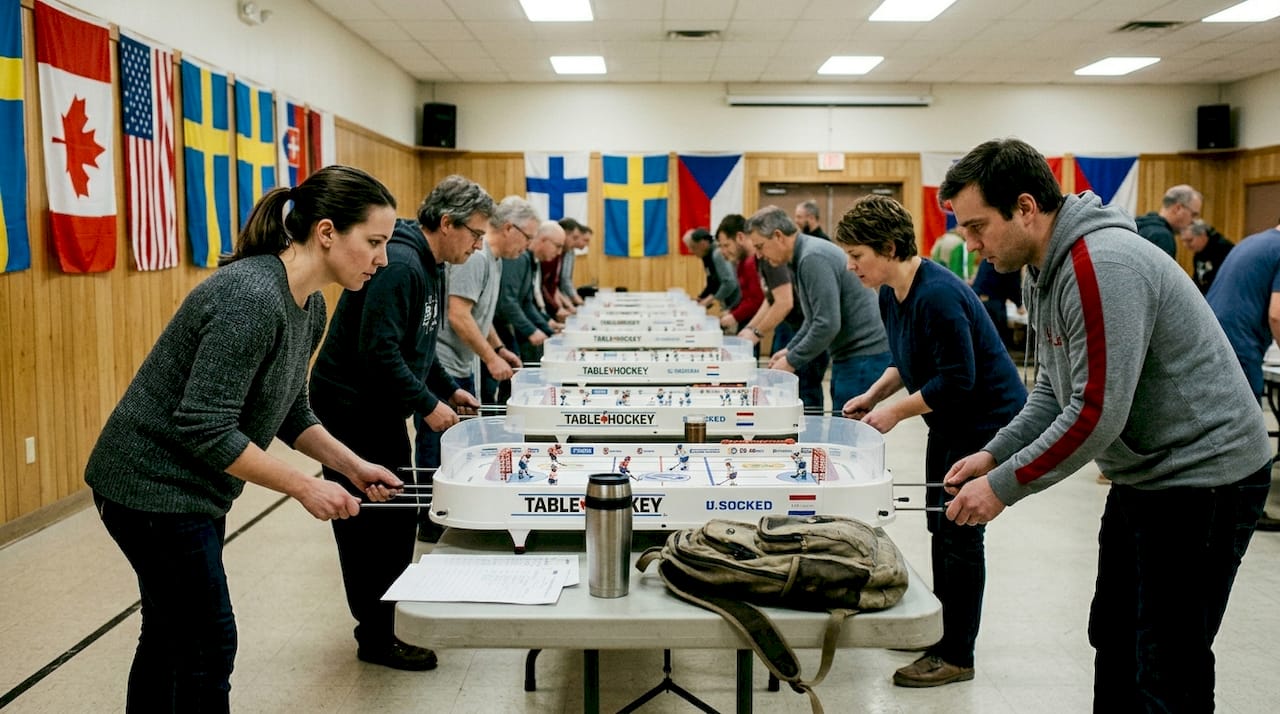
After the war, the game spread to Europe, particularly Scandinavia, where it became deeply embedded in sports culture. Sweden, Finland, and Russia developed strong competitive traditions around table hockey. The sport grew from a family activity into a structured competitive pursuit with regional leagues and national championships.
Key milestones in table hockey’s global growth:
- 1932: Donald Munro builds the first game in Toronto
- Post-WWII: The game spreads across Canada and into Europe
- 1970s to 1990s: Competitive table hockey grows in Scandinavia and Russia
- 2005: The ITHF is founded to oversee international play
- Present: World Championships held annually using the Stiga Play-Off model
| Era | Key development |
|---|---|
| 1930s | First game built; commercialized in Canada |
| 1940s | 75,000 Canadian families own Munro games |
| Post-WWII | Expansion into Europe, especially Scandinavia |
| 2005 | ITHF founded; global standardization begins |
| 2010s to 2026 | Annual world championships; growing online community |
The table hockey stats and growth data shows a sport that has expanded well beyond its Canadian roots. Today, players from dozens of countries compete at the highest level. The table hockey scene in Europe remains especially active, with national federations, ranked players, and regular tournaments across the continent.
Official rules and fascinating gameplay twists
Knowing the rules of table hockey adds a new layer of appreciation to every match. The ITHF has standardized gameplay so that tournaments run consistently no matter where in the world they are held.
Here is how an official match works:
- Each game lasts five minutes of playing time
- The puck is put in play with a center face-off at the start and after each goal
- If the score is tied at the end of regulation, sudden death overtime decides the winner
- Players must keep the puck moving. Stalling rules prevent anyone from holding possession too long
- Specific rod positions are regulated to keep play fair and fast
The ITHF rules cover these details precisely, and they exist for good reason. Without anti-stalling rules, a skilled player could simply hold the puck behind the net indefinitely. That area behind the goal, sometimes called “Gretzky’s Office” by fans, is actually a strategic zone in table hockey too. Controlling that space gives you time to read your opponent and set up a shot.
Pro Tip: When playing at home, adopt the five-minute match format from official play. It keeps games tight and competitive. You can find advanced play strategies that work within these time limits, and learning table hockey team roles helps everyone understand what each rod controls. For families interested in a specific regional style, Swedish style rules and tips offer a great starting point.
Left and right hand advantages are also real in table hockey. Most players develop a dominant side, and understanding which rod angles favor your stronger hand can give you an edge in close matches.
Why table hockey’s past is key to its future (and your family playroom)
Table hockey started as a do-it-yourself project. That fact matters more than it might seem. The sport was not invented by a corporation or a sports committee. It came from a parent who wanted to give his children something meaningful using only what was available. That origin shapes everything about how the game feels today.
The jump from an ironing board to a precision-engineered Stiga tournament table is a story of genuine innovation. Each generation of players and manufacturers added something. Better materials. Smoother rods. Standardized rules. The game kept improving because people cared enough to keep working on it.
For families, knowing this history adds real meaning to a match. You are not just playing a game. You are participating in something that started in a basement in 1932 and now connects players across continents. The skills kids develop with table hockey include coordination, focus, and competitive thinking. Those are the same skills Munro’s children were developing when they played the very first version.
The DIY spirit of table hockey’s origin is also an invitation. You do not need a tournament table to start. You need a surface, a puck, and people who want to play.
Ready to play or learn more? Join the global table hockey community
Table hockey has come a long way from a Toronto basement. Whether you are just discovering the sport or looking to sharpen your game, there is a place for you in the worldwide community.
Table Hockey Global connects players at every level, from first-timers to seasoned competitors. You can find guides on choosing the right table, improving your technique, and connecting with other fans around the world. For families, discover family play and community resources that make it easy to get started at home. The sport’s history is rich, the rules are learnable, and the community is open to everyone.
Frequently asked questions
Who invented table hockey and why?
Donald H. Munro Sr. invented table hockey in 1932 in Toronto as a creative Christmas gift for his children, built entirely from household scraps during the Great Depression.
What are the main types of table hockey games?
The two main types are rod hockey, with sliding and spinning 3D players, and bubble hockey, played under a dome with electronic scoring. Rod hockey and bubble hockey differ in design, with only flat-figure rod hockey used in official tournaments.
What makes ITHF table hockey tournaments unique?
ITHF tournaments use five-minute matches, specific face-off rules, sudden death overtime, and only flat-figure rod hockey tables, specifically the Stiga Play-Off model, for all competitive games.
How did table hockey become an international sport?
75,000 Canadian families owned Munro games by World War II, and the sport then spread to Europe. The ITHF was founded in 2005 to oversee global tournaments and standardize competitive play.
Can families play table hockey at home?
Yes, modern rod hockey tables are widely available, easy to set up, and simple enough for children aged 8 and up to enjoy right away.