How patience builds table hockey skills and confidence
TL;DR:
- Patience allows players to make strategic decisions and improves long-term skill development.
- Demonstrating patience during matches leads to better shot selection and mental focus.
- Parents can foster patience by praising process and implementing deliberate, slow-paced drills.
Parents watching their child play table hockey often assume speed is everything. Fast hands, quick reactions, rapid-fire shots. But the players who consistently improve and hold their nerve in competition share a different quality: patience. This article breaks down why patience matters so much in table hockey skill development, how it shows up in real matches, and what you can do to help your child build it. The goal is practical and direct. You will leave with a clearer picture of how this one mental trait shapes long-term growth at the table.
Table of Contents
- Why patience matters in table hockey skill development
- Patience on the table: Real-game scenarios
- Teaching and nurturing patience in young table hockey players
- Patience vs. other mental skills in table hockey
- Why patience is the real secret to table hockey growth
- Support your child’s table hockey journey
- Frequently asked questions
Key Takeaways
| Point | Details |
|---|---|
| Patience is key | It builds lasting skill and confidence beyond quick wins in table hockey. |
| Real-game impact | Patient decisions often lead to better outcomes on the table and fewer mistakes. |
| Parents can nurture patience | Supporting calm routines and positive mindsets helps young players grow. |
| Mental skills work together | Patience, focus, and resilience are equally important for competitive play. |
Why patience matters in table hockey skill development
Patience, in the context of table hockey, means the ability to wait for the right moment before acting. It is not passive. It is controlled readiness. A player who is patient reads the game, holds position, and resists the urge to shoot before a real opening exists.
Table hockey is a competitive sport governed by organizations like ITHF and WTHA, involving strategic control of players via rods to score goals. That word, strategic, is important. Strategy requires time. It requires a player to observe, plan, and execute rather than just react.
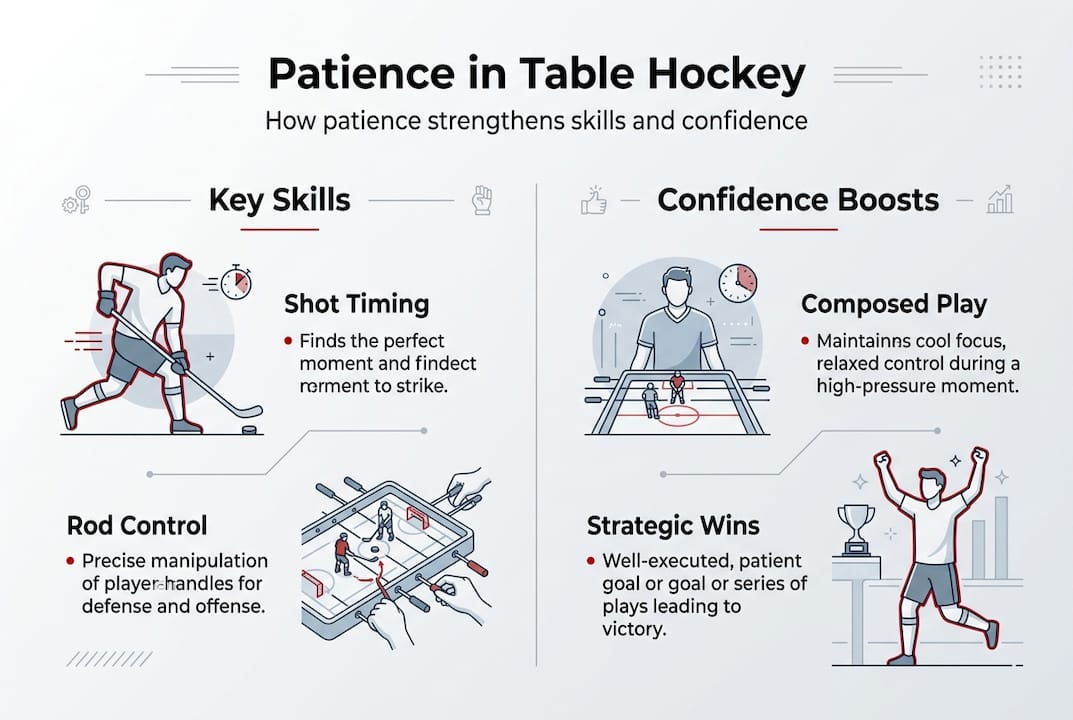
For young players, the learning curve is steep. They are building hand-eye coordination, rod control, and spatial awareness all at once. Mistakes are constant. Frustration follows. Patience is what keeps a child at the table long enough for those skills to click.
Skill mastery in table hockey comes from repetition and learning from errors. A player who gets frustrated and rushes through table hockey drills will absorb less than a player who slows down, notices what went wrong, and tries again with intention. The impatient player might complete more reps. The patient player will improve faster.
Here are the core benefits patience offers young table hockey players:
- Better shot selection: waiting for a clear lane instead of forcing a blocked attempt
- Fewer unforced errors: not rushing passes or defensive moves under pressure
- Stronger focus: staying mentally present across a full match rather than burning out early
- Faster learning: processing mistakes instead of repeating them on autopilot
- Greater resilience: accepting a bad period in a game without collapsing mentally
These benefits compound over time. A child who practices patience in drills carries it into matches. A child who carries it into matches builds confidence. Confidence feeds more patience. The cycle is self-reinforcing.
For parents, the takeaway is simple. When your child gets frustrated at the table, that moment is not a setback. It is a practice opportunity for the skill that will matter most as they advance. Pairing patience with advanced skills and strategies creates a foundation that lasts.
Table hockey rewards the player who controls the game, not the one who rushes it. Every rod movement is a decision. Patience turns those decisions into advantages.
Patience on the table: Real-game scenarios
Theory is useful. Watching patience work in an actual match is more convincing. Here are two short scenarios that show the difference clearly.
Scenario A: Patient play leads to a win. A young player is down by one goal with two minutes left. Instead of forcing shots from bad angles, they reset after each defensive stop, wait for the opponent to overcommit, and find a clean lane for a tying goal. They win in overtime.
Scenario B: Impatience causes a loss. A different player, also down by one, starts firing shots the moment they gain possession. Most are blocked. The opponent counters quickly. The deficit grows. The player loses by three.
| Factor | Patient player | Impatient player |
|---|---|---|
| Shot selection | Waits for open lanes | Shoots on instinct |
| Defensive response | Resets calmly | Rushes to attack |
| Mental state | Stays focused | Becomes reactive |
| Match outcome | Comeback win | Larger loss |
| Learning after game | Identifies what worked | Blames bad luck |
The ITHF table hockey community does not publish specific benchmarks on patience, but experienced players and coaches consistently point to composed decision-making as a separator at competitive levels.
Here are the key moments in a match where patience is most critical:
- The opening faceoff: resist the urge to attack immediately; read the opponent first
- After conceding a goal: pause mentally before the next play begins
- When possession is gained: hold before shooting; look for a real opening
- During a losing streak in a match: slow the pace rather than speeding up
- In the final moments: trust the process rather than gambling on a desperation move
Mastering faceoff techniques is one area where patience pays off immediately. A rushed faceoff gives up control. A patient one sets the tone.
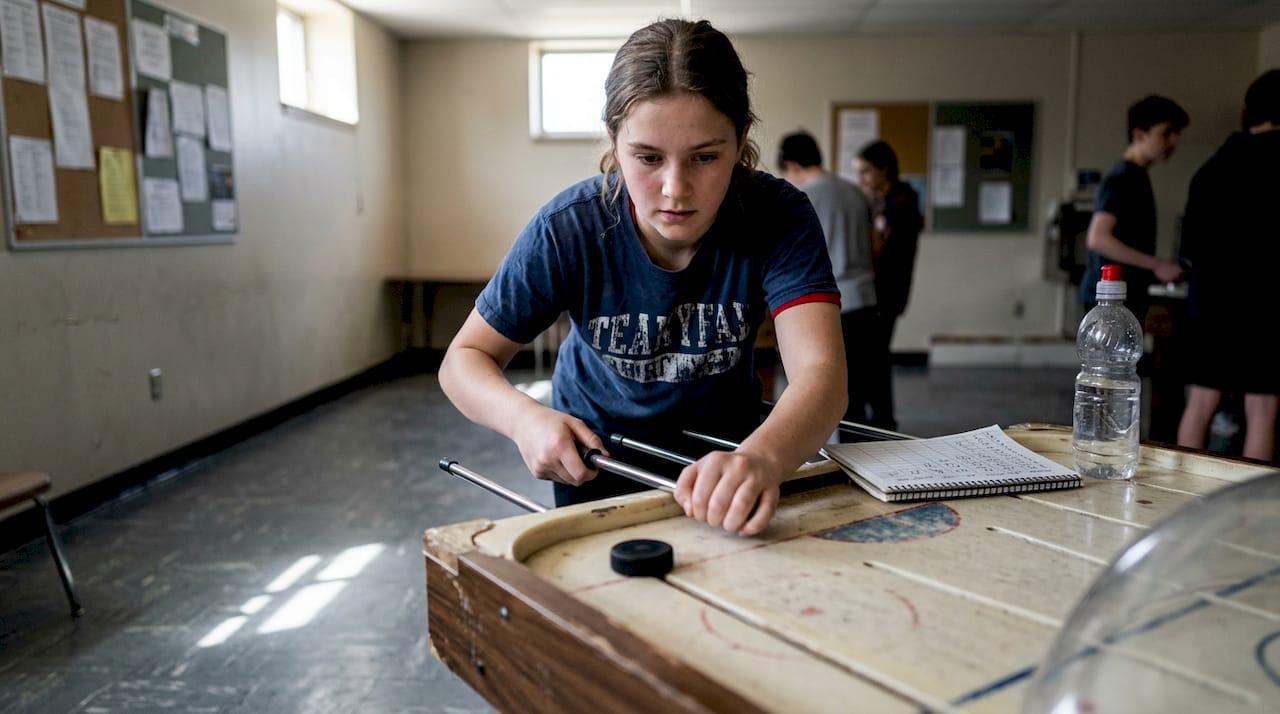
Pro Tip: After each practice session, ask your child to name one moment where they waited instead of rushing. Naming it reinforces the behavior and makes patience a conscious habit rather than an accident.
Teaching and nurturing patience in young table hockey players
Knowing patience matters is one thing. Building it in a child is another. Parents play a direct role here, and the methods are more practical than most expect.
Table hockey governed by organizations like ITHF and WTHA is a sport that rewards long-term investment in fundamentals. That means the environment you create around practice sessions shapes how your child develops the mental side of the game.
Here are actionable strategies parents can use:
- Praise the process, not just the result. When your child waits for a good shot instead of forcing one, acknowledge it. Say what you saw. This builds awareness.
- Set session goals around behavior, not scores. For example: today’s goal is to pause for one second before every shot.
- Normalize mistakes. Treat errors as data. Ask what happened rather than reacting to the outcome.
- Use slow-paced drills. Deliberate, unhurried practice sessions train the nervous system to stay calm under pressure.
- Limit session length when frustration peaks. Ending on a calm note is more valuable than grinding through anger.
Research on skill acquisition consistently shows that deliberate practice with focused attention outperforms high-volume repetition without reflection. Quality of attention matters more than quantity of reps.
Statistic callout: Studies on youth sport development show that children who receive process-focused feedback improve technical skills measurably faster than those who receive only outcome-focused feedback.
Tracking progress also reinforces patience. When a child can see their own improvement over weeks and months, they internalize that growth takes time. Tools for tracking skill progress help make that timeline visible and real.
Pro Tip: After a loss, ask your child: “What is one thing you did well today?” Then ask: “What is one thing you want to try differently next time?” This frames losses as steps forward, not failures.
Patience vs. other mental skills in table hockey
Patience does not operate alone. It works alongside other mental traits that young players need to develop. Understanding how these qualities relate helps parents support a more complete mental game.
The ITHF table hockey competitive framework does not publish specific psychological benchmarks, but players who advance consistently demonstrate a cluster of mental skills working together.
| Mental skill | What it does | How patience supports it |
|---|---|---|
| Focus | Keeps attention on the current play | Patience reduces panic that breaks focus |
| Resilience | Recovers from setbacks quickly | Patience prevents overreaction to mistakes |
| Confidence | Trusts in one’s own ability | Patience allows time for confidence to build |
| Decision-making | Chooses the right move at the right time | Patience creates space for better choices |
Patience is the foundation that makes the other skills more effective. A resilient player who is also impatient will recover from a mistake but immediately make another one. A confident player without patience will take unnecessary risks. Patience slows the game down mentally, which gives focus, resilience, and confidence room to function.
Here is how patience specifically enhances each trait:
- Focus: Impatience creates mental noise. Patience quiets it, allowing the player to see the game more clearly.
- Resilience: A patient player does not catastrophize a bad goal. They reset and continue.
- Confidence: Confidence grows when decisions pay off. Patient decisions pay off more often, which builds confidence over time.
At advanced levels, the gap between players often comes down to who can stay composed the longest. Building mental resilience and learning to balance for better play are areas where patience creates a direct performance advantage.
Why patience is the real secret to table hockey growth
Most beginner coaching focuses on physical skills: rod control, shot accuracy, defensive positioning. These are visible and measurable. Patience is harder to see, so it gets less attention. That is a mistake.
The players who burn out early are rarely the ones who lacked skill. They are the ones who could not tolerate the slow pace of improvement. They wanted results faster than the game delivers them. Patience is what keeps a child in the sport long enough for their skills to become real.
This applies to parents too. Watching your child lose repeatedly is difficult. The urge to intervene, to coach from the sideline, to push harder, is understandable. But patience from the parent creates permission for the child to develop at their own pace. Pressure from the outside often produces the opposite of what parents want.
The trends transforming table hockey in 2026 point toward more structured youth development pathways. That means patience is becoming a recognized part of player growth, not just a soft skill.
The child who learns to wait for the right moment at the table is learning something that will serve them far beyond the game itself.
Enjoyment and persistence are the real long-term outcomes. A child who enjoys the process stays in the sport. A child who stays in the sport improves. Patience is what makes the process enjoyable enough to continue.
Support your child’s table hockey journey
Patience is built over time, and the right resources make that process more structured and rewarding. Table Hockey Global offers a full range of guides, drills, and community support designed for players at every level, from first-timers to competitive athletes.
You can explore table hockey resources covering everything from beginner fundamentals to advanced mental game strategies. For parents focused on skill building, the game-elevating drills section provides structured practice formats that reward calm, deliberate play. The community also connects your child with players around the world, giving them context for their own development and motivation to keep improving.
Frequently asked questions
How can I help my child stay patient during table hockey losses?
Encourage them to treat losses as information rather than failure, focusing on one specific thing to improve next time. Skill development in table hockey requires repeated practice and learning from mistakes, so each loss is part of the process.
Is patience more important than quick reflexes in table hockey?
Both matter, but patience helps players make smarter choices and avoid impulsive errors, especially at higher levels. Table hockey is a competitive sport built on strategic control and decision-making, not just reaction speed.
Are there exercises that improve patience in table hockey practice?
Yes, slow-paced drills and delayed-decision scenarios reinforce calm, thoughtful play over time. Effective table hockey drills build both mental resilience and patience in young players.
What mental traits complement patience in table hockey?
Focus, resilience, and confidence all work together with patience to support better performance. These traits reinforce each other, and patience in competitive play gives the other skills the space they need to function effectively.
Recommended
- Effective table hockey drills to elevate your game – Table Hockey Global
- Track table hockey progress and improve your game in 2026 – Table Hockey Global
- Master advanced table hockey play: skills and strategies 2026 – Table Hockey Global
- Table hockey team roles: guide for players and fans – Table Hockey Global

Like our articles? Add Table Hockey Global as a preferred source, and Google will show you more of them.