Table hockey team roles: guide for players and fans
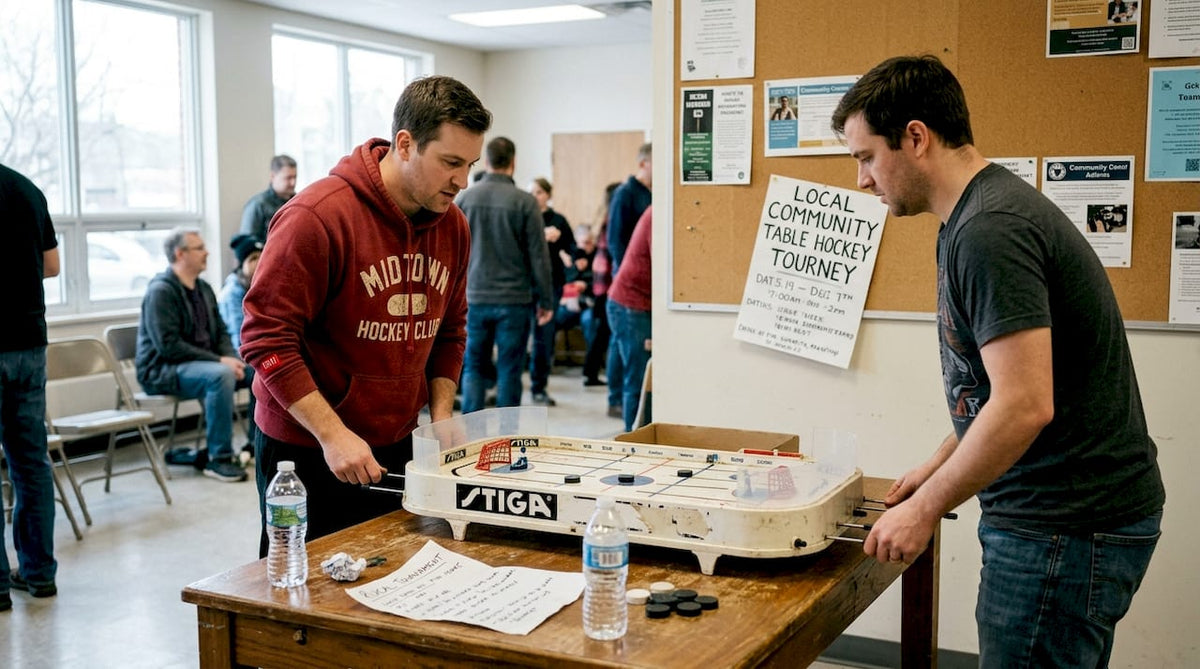
Most people assume table hockey works like ice hockey, with defenders, forwards, and goalies each controlled by different players. That assumption is wrong. Table hockey is primarily a 1v1 individual sport governed by the ITHF (International Table Hockey Federation), where one player controls every rod and every figure on the table. Team events exist, but they work nothing like what you’d expect. This article covers how team tournaments are actually structured, how rod control works, what rare doubles formats look like, and what any player needs to know to perform well in a team setting.
Table of Contents
- Breaking the myth: How table hockey teams actually work
- Mastering the rods: Individual control in table hockey
- Team tournaments and scoring: How team wins are built
- Rare exceptions: Doubles play and casual variants
- Why table hockey thrives without standard team roles
- Take your table hockey knowledge further
- Frequently asked questions
Key Takeaways
| Point | Details |
|---|---|
| No fixed team roles | Table hockey is played individually with all figures controlled by one person, not by assigned positions. |
| Teams are points totals | Team competitions add up individual players’ results, so success relies on solo performance. |
| Doubles rules are unofficial | Sharing rods in doubles is done informally and isn’t governed by any set roles or standards. |
| Full-table mastery is key | The best table hockey players develop both defense and offense skills by mastering every figure themselves. |
Breaking the myth: How table hockey teams actually work
Table hockey has a team problem, and it’s mostly a perception problem. New players often arrive expecting something like ice hockey, where each person on a team has a clear job. That’s not how it works here.
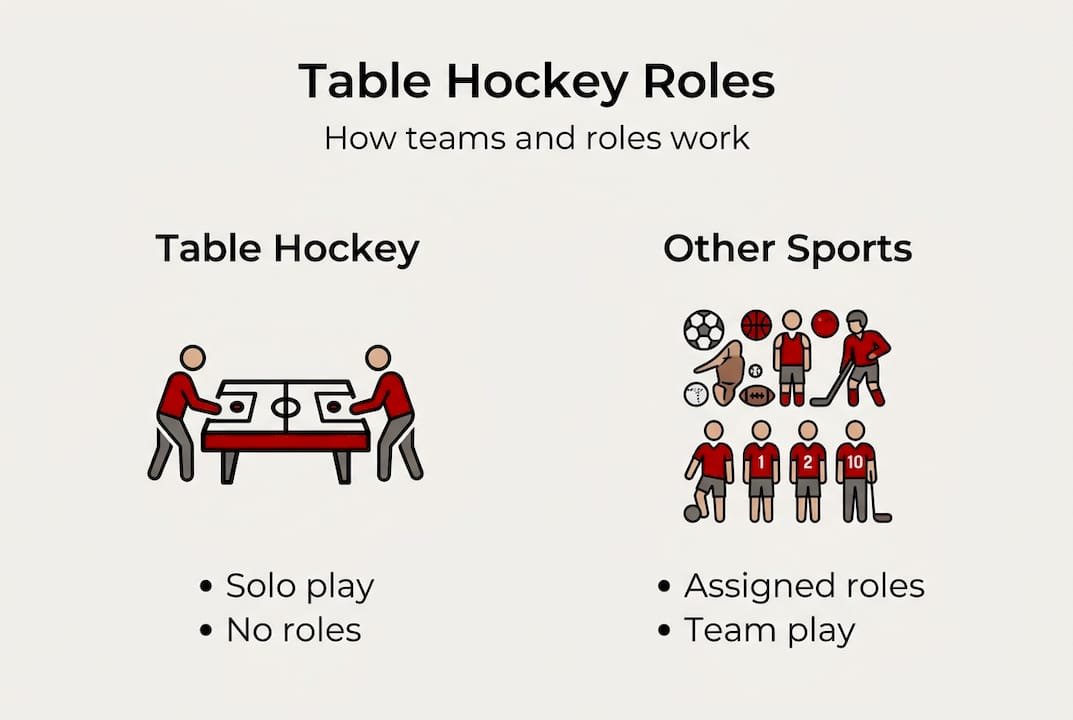
In competitive table hockey, individual matches dominate both casual and official play. Even in national team competitions, every match is a 1v1 contest. There are no defenders or forwards assigned to specific players. One person sits at the table and controls everything.
So what does a “team” mean in table hockey? It means a group of individuals representing a country or club, each playing their own separate matches. The team’s total score is the sum of those individual results. Think of it more like a track and field relay scoring system than a soccer match.
Here’s how table hockey team events compare to other sports:
| Sport | Team format | Role assignment |
|---|---|---|
| Table hockey | Individual matches summed | None |
| Foosball (doubles) | 2 players share rods | Fixed rod positions |
| Ice hockey | 6 players on ice | Goalie, defense, forward |
| Chess team events | Individual boards summed | Board order only |
The ITHF Team World Championships follow this exact model. National teams compete, but every match inside that competition is individual. Sweden’s early dominance in those events came not from tactical team coordination but from having multiple elite solo players.
Key facts about table hockey team events:
- No positional assignments during matches
- Team success depends on depth of individual talent
- Players are selected based on individual rankings
- Match results are added together for a team total
- No in-game communication between teammates affects play
“In table hockey, a strong team is simply a collection of strong individuals. There are no roles to fill, only results to deliver.”
This structure is worth understanding before you look at table hockey statistics, because those numbers reflect individual performance, not team coordination.
Mastering the rods: Individual control in table hockey
With the basics of team aggregation clear, let’s examine how actual gameplay emphasizes full-table individual control.
In table hockey, one player controls all figures on their side of the table. That includes the goalie, the defenders, and the forwards. All of them. At once. This is the core mechanic that separates table hockey from foosball and from most people’s mental image of the game.
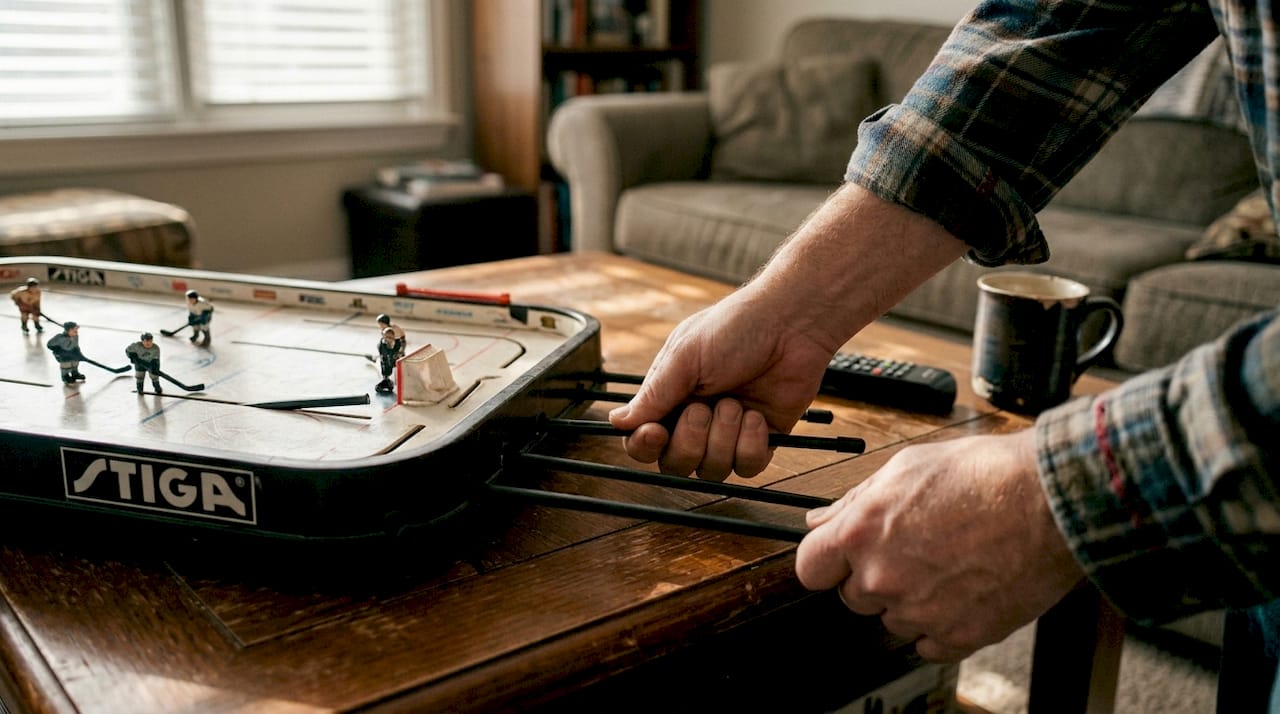
The standard Stiga-style table has multiple rods, each connected to a row of players. Rotating and sliding each rod moves those figures. A skilled player learns to shift between rods quickly, maintain puck control, and set up shots without giving the opponent time to react.
Here’s a breakdown of the typical rod layout and function:
| Rod position | Figures controlled | Primary function |
|---|---|---|
| Goalie rod | 1 goalie | Shot blocking |
| Defender rod | 2 defenders | Puck clearance, passing |
| Forward rod | 3 forwards | Shooting, puck possession |
Face-off mechanics are another area where individual knowledge matters. The center forward is used for the opening play, and knowing how to win face-offs consistently is a real skill. You can study table hockey faceoffs in detail to get an edge here.
Steps to build solid rod control:
- Start with the forward rod and practice basic shooting angles
- Move to the defender rod and practice puck trapping and passing
- Practice goalie positioning against common shot patterns
- Combine all three in live play, focusing on smooth transitions
- Time your rod switches to match the pace of play
Pro Tip: Keep your grip loose on rods you’re not actively using. Tension in your hands slows down transitions and reduces your reaction speed when the puck changes direction.
For more on grip technique, the guide on gripping table hockey rods covers optimal hand placement in detail.
In foosball doubles, two players each take specific rods and never switch. Table hockey doesn’t work that way, even in doubles formats. The expectation in standard play is always full-table individual control.
Team tournaments and scoring: How team wins are built
Understanding control at the individual level, let’s see how that influences the outcome of team tournaments.
Team tournaments in table hockey are scored by adding up the results of individual matches. Each player on the team plays their assigned opponent from the other team. The player who wins earns points for their team. Those points are totaled at the end.
National teams in ITHF are built on individual rankings. Sweden’s early dominance in World Championships came from having a deep pool of top-ranked solo players, not from any in-game team strategy or role assignment. The same pattern holds for other successful nations.
Here’s a simplified look at how team scoring works in a round-robin team event:
| Match | Player A result | Points earned |
|---|---|---|
| Match 1 | Win | 2 |
| Match 2 | Loss | 0 |
| Match 3 | Win | 2 |
| Match 4 | Draw | 1 |
| Team total | 5 |
Key factors that determine team success:
- Number of players ranked in the top 50 nationally
- Consistency across multiple matches in one day
- Experience in high-pressure individual play
- Depth of the squad when top players underperform
Statistic: Countries with at least three players ranked in the top 20 of their national league have historically won over 70% of team-format matches at regional championships.
The path from local play to national team representation follows a clear line. Local leagues build individual rankings. Strong rankings earn selection. Selection leads to team events. But at every stage, the work is individual. Track your own progress using table hockey player stats tools to see where you stand.
There are no shortcuts through teamwork here. A team with five average players will lose to a team with two elite players every time, because the scoring system rewards individual excellence above all else.
Rare exceptions: Doubles play and casual variants
While formal competition is all about individual control, casual play sometimes allows for splitting responsibilities.
Doubles formats in table hockey are uncommon. They don’t appear in major ITHF competitions in any standardized form. But in casual settings, club nights, and informal tournaments, some groups do experiment with two players sharing one side of the table.
In these setups, each player typically takes two or three rods. One person might handle the goalie and defenders while the other controls the forwards. But rod splitting in casual play has no official rules behind it. Every group figures it out on their own.
This is very different from foosball doubles, where the rod division is standardized and practiced. In foosball, one player always takes the goalie and two-bar, while the other handles the five-bar and three-bar. That split is consistent and well-documented. Table hockey doubles has no equivalent standard.
Practical tips for casual doubles play:
- Agree on rod assignments before the game starts
- Communicate clearly when the puck is near a shared zone
- Avoid grabbing a rod your partner is already controlling
- Rotate assignments between games to keep things balanced
- Keep it simple: forward player attacks, back player defends
Pro Tip: In casual doubles, the player controlling the forward rod should call out “mine” or “yours” when the puck enters a contested area. It sounds basic, but it prevents most collisions and confusion.
For groups using table hockey as a social or team-building activity, the format works well even without official rules. More ideas on using the game in group settings are available through team building table hockey resources.
Doubles play is best treated as a fun variation, not a competitive format. The game’s design centers on individual control, and that’s where its depth comes from.
Why table hockey thrives without standard team roles
Most sports discussions assume that role specialization makes a game richer. Ice hockey has positions. Foosball doubles has fixed rod assignments. Even casual board games often assign roles. Table hockey does none of that, and it’s better for it.
Full-table individual control means every player must develop mastery across all positions simultaneously. You can’t hide a weak goalie behind a strong forward. You can’t rely on a partner to cover your defensive gaps. Every weakness is visible, and every strength is yours alone to build.
This structure has driven skill development across the global table hockey community in a way that role-based formats simply can’t replicate. Players who compete at the top level have spent years refining every part of their game, not just one rod or one function.
Team chemistry in table hockey exists, but it lives in preparation, not in play. Teams that perform well together share training methods, analyze opponents together, and push each other in practice. That collective effort shows up in the score sheet as a sum of individual excellence.
For players ready to go deeper, advanced table hockey strategies cover the tactical layers that separate good players from great ones. The absence of team roles isn’t a limitation. It’s the point.
Take your table hockey knowledge further
Table Hockey Global is the world’s largest community for players at every level, from first-time beginners to seasoned competitors. Whether you’re learning the basics of rod control or tracking results from international team tournaments, there’s a place for you here.
Explore guides on skills, strategy, and event formats at Table Hockey Global. Stay current with what’s shaping the sport through coverage of table hockey trends in 2026. Connect with players from dozens of countries, find local leagues, and access resources that match your current level. The community is active, the content is practical, and the game is waiting.
Frequently asked questions
Do table hockey teams have assigned player roles like ice hockey?
No. Table hockey is individual, with one player controlling all figures per side. There are no assigned roles within a match, even in team competitions.
How are team scores calculated in table hockey tournaments?
Team scores are summed from each player’s individual match results. No positional division happens during play; every point comes from a 1v1 outcome.
Can you play doubles or share rods in table hockey?
Yes, casual and informal doubles formats exist where two players split rod control, but no standard assignment of rods is documented or officially recognized.
What skills matter most for team success in table hockey?
Individual rankings and consistency drive team results. Strong teams are built from multiple elite solo players, not from coordinated in-game roles or positional assignments.
Recommended
- Table hockey statistics guide: players and fans 2026 – Table Hockey Global
- Master advanced table hockey play: skills and strategies 2026 – Table Hockey Global
- Table Hockey in Europe: Your Guide to the Thriving Scene – Table Hockey Global
- Discover table hockey: family fun and global community – Table Hockey Global

Like our articles? Add Table Hockey Global as a preferred source, and Google will show you more of them.